Fiber Optic or Copper Cable? Which Should Be Used for Factories, Hotels and Corporate Networks?
One of the most common questions when building a new network infrastructure is: Should fiber optic or copper cabling be used?
In reality, there is no single correct answer. Distance, required bandwidth, electromagnetic environment, PoE requirements, connected devices and future capacity needs all directly affect cable selection.
In many corporate projects, the right solution is not to use only fiber or only copper, but to use both technologies in the right parts of the network.
What Is the Main Difference Between Fiber Optic and Copper Cable?
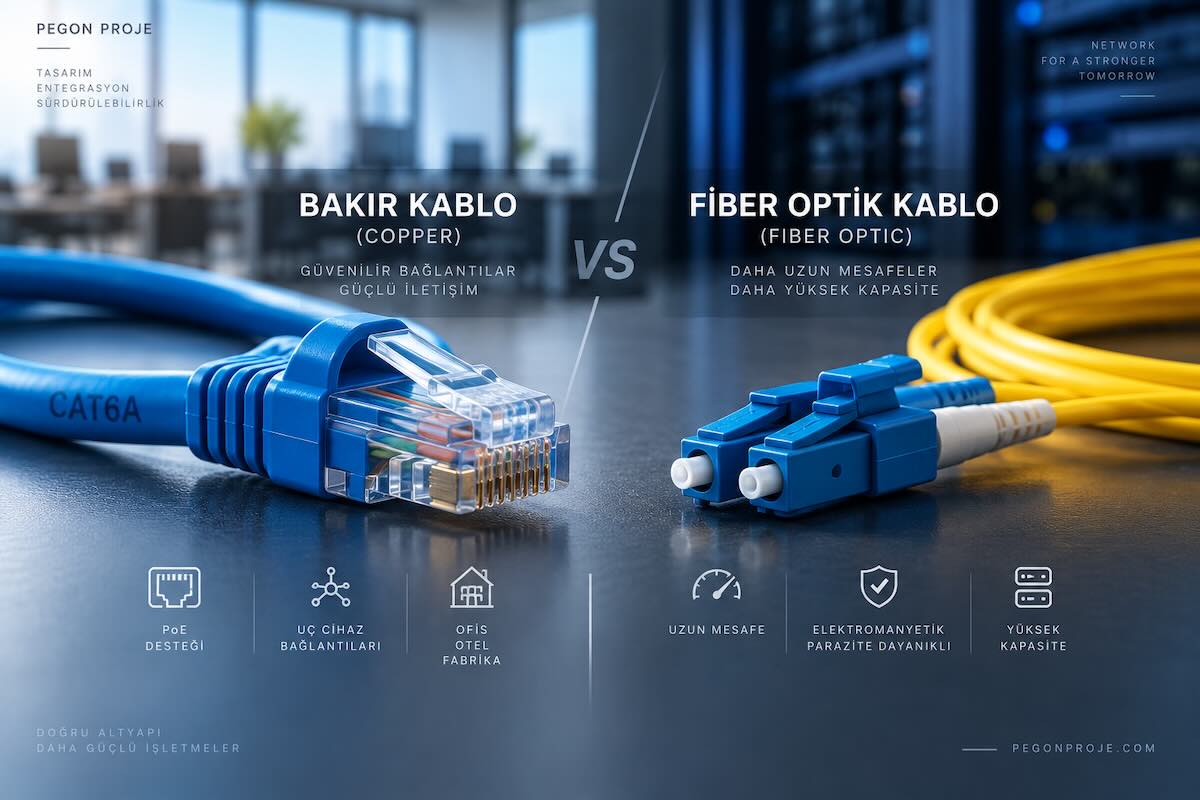
Copper Ethernet cables transmit data using electrical signals. Fiber optic cables transmit data using light.
This fundamental difference also affects the characteristics of the two infrastructures in terms of distance, electromagnetic interference, connection equipment and supplying power to endpoint devices.
For example, copper cabling is widely used to connect Ethernet endpoint devices such as computers, IP cameras, IP phones and access points. Fiber is particularly advantageous for network backbones, connections between floors or buildings and long-distance links.
When Should Copper Cable Be Used?
In corporate buildings, copper cabling systems such as Cat6 and Cat6A are widely used, particularly for endpoint connections.
One of the key advantages of copper infrastructure is its ability to provide Power over Ethernet (PoE) with compatible network equipment. This allows both data and electrical power to be delivered over the same Ethernet connection.
This provides an important advantage for devices such as:
-
IP cameras,
-
wireless access points,
-
IP phones,
-
access control devices,
-
other PoE-enabled IP devices.
For standard four-pair copper Ethernet connections, the channel length is generally limited to 100 meters. For longer distances, a different network architecture or fiber optic connection should be considered.
When Should Fiber Optic Cable Be Used?
Fiber optic cabling is a strong option, particularly for long-distance connections, high-capacity backbone links and environments where electromagnetic interference is an important consideration.
One of the major advantages of fiber optic cable is that it is not affected by electromagnetic interference because it does not carry electrical data signals. This can be particularly important in factories and industrial facilities.
Fiber optic infrastructure can be preferred particularly for:
-
connections between the main server room and floor or field cabinets,
-
connections between different buildings,
-
long-distance network links,
-
high-capacity switch uplinks,
-
industrial areas with significant electromagnetic interference.
If Fiber Optic Is Faster, Why Isn't It Used Everywhere?
Although fiber optic provides important advantages for high-capacity and long-distance connections, connecting every endpoint directly with fiber is not necessary or suitable for every project.
Many IP cameras, access points, IP phones and similar endpoint devices use standard RJ45 Ethernet connections. A significant number of these devices can also receive power through PoE.
Fiber optic cable, on the other hand, does not by itself provide standard PoE power to an endpoint. In projects where fiber is extended directly to the endpoint, additional equipment or a different architecture may be required to meet the device's connectivity and power requirements.
For this reason, cable selection should consider not only maximum speed but also how the device will be connected and powered.
Should Factories Use Fiber or Copper?
In factories, a hybrid network architecture combining fiber and copper is often more appropriate.
Production environments may contain motors, drives, power cables and various electrical equipment that create more challenging electromagnetic conditions. Fiber optic cabling can therefore provide significant advantages for long-distance and critical backbone connections.
For example, a fiber backbone can be installed from the main server room to network cabinets located throughout production areas. From these cabinets, copper cabling can then be used for IP cameras, access points and other Ethernet endpoint devices where distance and environmental conditions are suitable.
This approach allows the distance and electromagnetic interference advantages of fiber to be combined with the endpoint connectivity and PoE advantages of copper within the same architecture.
Should Hotels Use Fiber or Copper?
A similar approach can be used in large hotels and resort projects.
A fiber optic backbone can be installed between the main server room and floor cabinets, separate accommodation blocks or remote technical areas. Connections from floor cabinets to access points, IP cameras, IP phones and other Ethernet devices can then be provided through copper cabling according to project requirements.
Particularly in large resort properties spread across extensive areas, distances should be evaluated at the beginning of the project. Poorly planned cabinet locations or cable routes can create the need for additional active equipment and infrastructure later in the project.
Which Is More Suitable for Offices and Corporate Buildings?
One common architecture in office and corporate environments is to use fiber for the backbone and copper for endpoint connections.
Fiber connections can be installed between the main server room and network cabinets on different floors. Copper horizontal cabling can then be used from the floor cabinets to computers, access points, IP phones, cameras and other endpoint devices.
However, every project is different. The architecture should be determined according to building size, number of users, distances, network capacity and future expansion plans.
Fiber or Copper? What Should Be Considered When Making the Decision?
When selecting cabling, it is not enough to consider only the initial investment cost or the maximum speed supported by the cable.
The following questions should be evaluated together during the engineering design process:
-
Distance: How long is the connection?
-
Capacity: How much network capacity is required today and in the future?
-
PoE: Does the endpoint need to receive power over the same cable?
-
Electromagnetic Environment: Are there significant sources of electromagnetic interference along the cable route?
-
Endpoint Device: Which physical network interfaces does the connected device support?
-
Future Planning: Is network capacity expected to increase in the coming years?
The answers to these questions help determine where fiber and where copper should be used within the project.
Fiber and Copper Are Not Competitors — They Complement Each Other
It is not always correct to view fiber and copper cabling as competing alternatives in corporate network infrastructure.
In many projects, the most appropriate architecture is a hybrid design that uses fiber optic cabling for high-capacity and long-distance connections and copper cabling for endpoint connections.
The important point is not to use the highest cable category or the greatest amount of fiber, but to use the right cable in the right place.
For more detailed information about the overall structure of corporate network infrastructure, see our What Are Structured Cabling Solutions? guide.
Let's Plan Your Fiber and Copper Network Infrastructure with Pegon Proje
At Pegon Proje, we do not focus solely on cable category or fiber type when designing cabling projects. We evaluate distance, network capacity, PoE requirements, the electromagnetic environment, active network architecture and future expansion requirements together.
For factories, hotels, industrial facilities and corporate buildings, we design fiber and copper infrastructure according to project requirements to create an end-to-end network infrastructure.
Explore our fiber and copper cabling infrastructure services on our Passive Network Solutions page.
For factory-terminated and pre-tested fiber infrastructure options, see our Custom Network Fiber Solutions page.
Phone: +90 533 920 99 14
Email: pegon@pegonproje.com