What Is a Hotel IPTV System? How Does It Work and How Is It Installed?
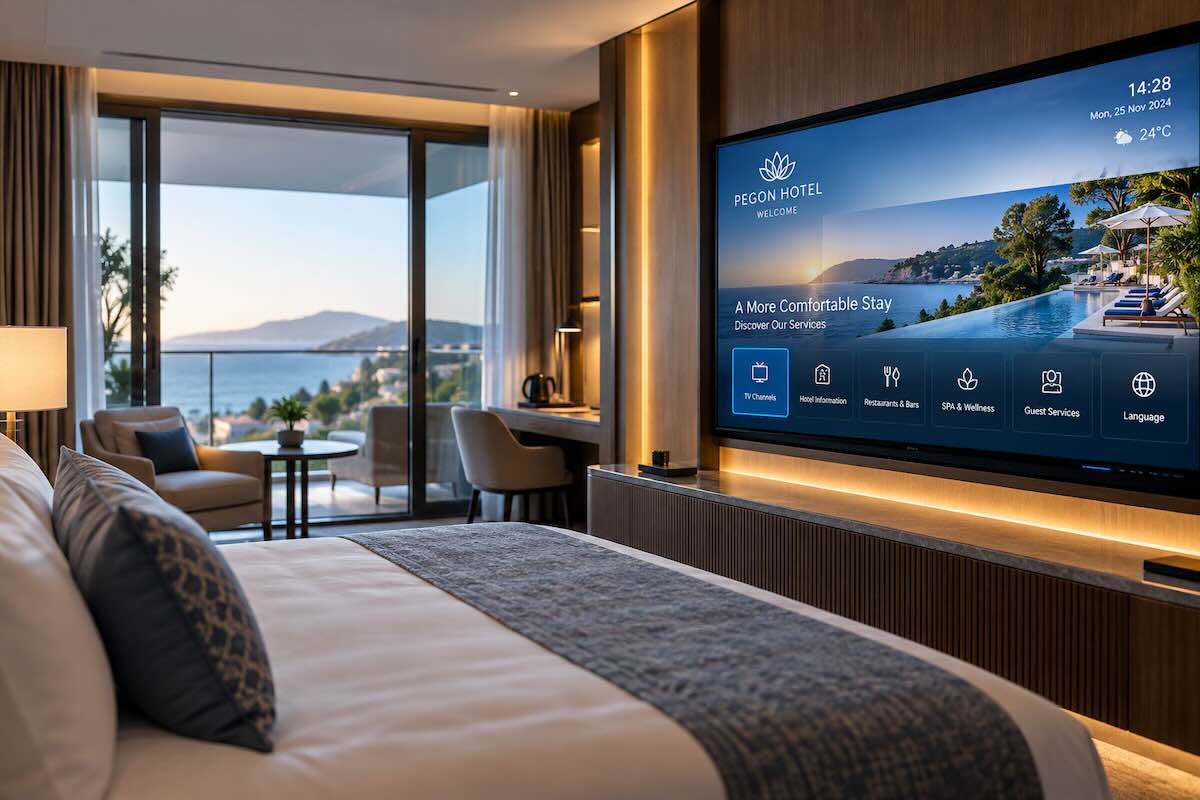
Hotel television systems are no longer limited to delivering TV channels to guest rooms. With IPTV systems, television broadcasts can be distributed over an IP network, while guests can also be provided with hotel information, welcome screens, announcements and, depending on the project scope, various interactive services.
So, what is a hotel IPTV system, how does it work and what should be considered when installing IPTV infrastructure in a hotel?
What Is a Hotel IPTV System?
IPTV (Internet Protocol Television) is a technology that enables television and video content to be delivered over an IP-based network infrastructure.
Unlike traditional television distribution systems, IPTV allows content to be delivered to relevant devices through the hotel's network infrastructure. This architecture enables centralized management of television broadcasts and, depending on project requirements, allows different digital services to be provided through the same platform.
Hotel IPTV systems can be used not only in guest rooms but also in lobbies, restaurants, SPA facilities, meeting rooms and common areas.
How Does a Hotel IPTV System Work?
In an IPTV system, broadcasts received from satellite, terrestrial television or other content sources are processed by a central system and prepared for distribution over the IP network.
A simplified IPTV architecture can be represented as follows:
Broadcast Source → Headend / IPTV Platform → Network Infrastructure → IPTV Receiver or Compatible TV → Guest
The system architecture can vary depending on the IPTV platform, televisions, content sources and the services the hotel intends to provide.
1. Broadcast Sources
The first stage of the system consists of television and other content sources. Satellite broadcasts, terrestrial broadcasts or other content sources included within the project scope can be received by the IPTV platform.
2. Headend and IPTV Platform
The headend is the central infrastructure used to receive, process and prepare broadcasts from different sources for distribution.
Depending on the project architecture, components such as encoders, decoders, gateways, servers and management software may be included in the system.
3. Distribution over the Network
Prepared broadcasts are delivered to the relevant endpoints through the hotel's IP network infrastructure. In environments where the same broadcasts need to be distributed efficiently to a large number of televisions, network technologies such as multicast can be used.
For this reason, IPTV performance does not depend solely on the televisions or IPTV platform. Switch capacity, uplink connections, VLAN architecture, multicast management and physical cabling infrastructure are also part of the system design.
4. In-Room Television or IPTV Receiver
Depending on the system architecture, content transported over IP can be displayed directly by a compatible television or through an external IPTV receiver.
The appropriate method should be determined according to the capabilities of the existing televisions, the IPTV platform and whether the hotel project involves a renovation or a new installation.
Is Hotel IPTV Used Only for Television Broadcasting?
No. One of the important advantages of hotel IPTV systems is that, depending on the project scope, the television screen can be transformed into a digital platform for guest communication.
Depending on system capabilities and integrations, IPTV can be used to provide:
-
television channels,
-
personalized welcome screens,
-
hotel and facility information,
-
information about restaurants, SPA facilities and other services,
-
announcements and informational content,
-
multilingual content,
-
Video on Demand (VoD) and other interactive services depending on the project scope.
The functions that can be provided depend on the capabilities of the selected IPTV platform and its integrations with other hotel systems.
What Should Be Considered When Installing a Hotel IPTV System?
Installing IPTV involves more than placing televisions in guest rooms or installing a central server. For the system to operate properly, the broadcast infrastructure and network infrastructure should be evaluated together.
Network Capacity
IPTV broadcasts can generate continuous data traffic across the network. Switches, uplink connections and the network backbone should therefore be planned according to the traffic expected from the system.
Multicast Configuration
In IPTV projects where many users watch the same live broadcasts, multicast can help reduce unnecessary duplication of the same content across the network.
However, the active network equipment and network configuration need to be designed in accordance with the IPTV architecture being used.
Fiber and Copper Cabling
In large hotel and resort projects, a fiber optic backbone can be used between the main server room and floor cabinets or separate accommodation blocks. Copper Ethernet cabling can then be used for endpoint connections within each floor according to project requirements.
For more detailed information about where fiber and copper infrastructure should be used, see our Fiber Optic or Copper Cable? Which Should Be Used for Factories, Hotels and Corporate Networks? guide.
Integration with Existing Systems
Depending on the project scope, the hotel IPTV platform can be integrated with other hotel systems. This can enable functions such as personalized welcome content or services associated with different hotel facilities.
However, integration possibilities depend on the interfaces supported by the IPTV platform and other systems, so these requirements should be identified at the beginning of the project.
Can an Existing Hotel Be Upgraded to an IPTV System?
Yes, but the existing infrastructure should not automatically be assumed to be suitable for IPTV.
When planning an IPTV migration in an existing hotel, the network cabinets, switches, fiber and copper cabling, television models, existing broadcast system and server room infrastructure should first be evaluated.
This makes it possible to determine which parts of the existing infrastructure can continue to be used and which components need to be upgraded.
Especially in operating hotels where the migration needs to be carried out in phases, the implementation plan should also be coordinated with hotel operations.
Why Is Network Infrastructure Important for a Hotel IPTV System?
Because IPTV is an IP-based system, broadcast quality is directly related to the performance of the network infrastructure.
Insufficient uplink capacity, incorrect multicast configuration or problems within the physical network infrastructure can contribute to issues such as video freezing, delays or interruptions.
For this reason, an IPTV project should not be considered independently from the active and passive network infrastructure.
Explore our switch and network infrastructure services on our Active Network Solutions and Passive Network Solutions pages.
What Questions Should Be Asked When Choosing a Hotel IPTV System?
Before selecting an IPTV platform or system architecture, it is useful to answer the following questions:
-
How many rooms and televisions will be connected to the system?
-
Which televisions and broadcast sources will be used?
-
Will the system provide only live television, or will interactive services also be required?
-
Can the existing televisions and network infrastructure be used?
-
What type of network backbone connects different hotel blocks or remote areas?
-
Is integration with other hotel systems required?
-
Will the system need to support additional rooms, channels or services in the future?
Answering these questions at the beginning of the project helps create an IPTV infrastructure that supports not only current requirements but also future use cases.
Plan Your Hotel IPTV Infrastructure with Pegon Proje
At Pegon Proje, we do not approach hotel IPTV projects solely as television and broadcast systems. We evaluate the headend infrastructure, active network, fiber and copper cabling, server rooms and required integrations together according to the needs of the project.
If you are planning a new hotel or resort project, or considering migrating the television infrastructure of an existing property to IPTV, we can technically evaluate your current infrastructure and requirements.
Explore our IPTV infrastructure solutions on our IP TV Systems page.
Phone: +90 533 920 99 14
Email: pegon@pegonproje.com