EN 54 Standards to Consider When Selecting a Fire Detection System for Industrial Facilities
Selecting a fire detection system for a factory or industrial facility involves more than choosing detectors and a fire alarm control panel. Production areas, warehouses, electrical rooms, technical spaces and administrative areas within the same facility may have very different environmental conditions and fire risks.
For this reason, system design should consider not only the facility's risks and fire scenarios but also the compliance of the selected equipment with the relevant standards.
One of the main families of standards associated with fire detection and alarm systems is EN 54. So, what is EN 54, which parts are directly relevant to fire detection systems, and what should be considered when selecting equipment for industrial facilities?
What Is EN 54?
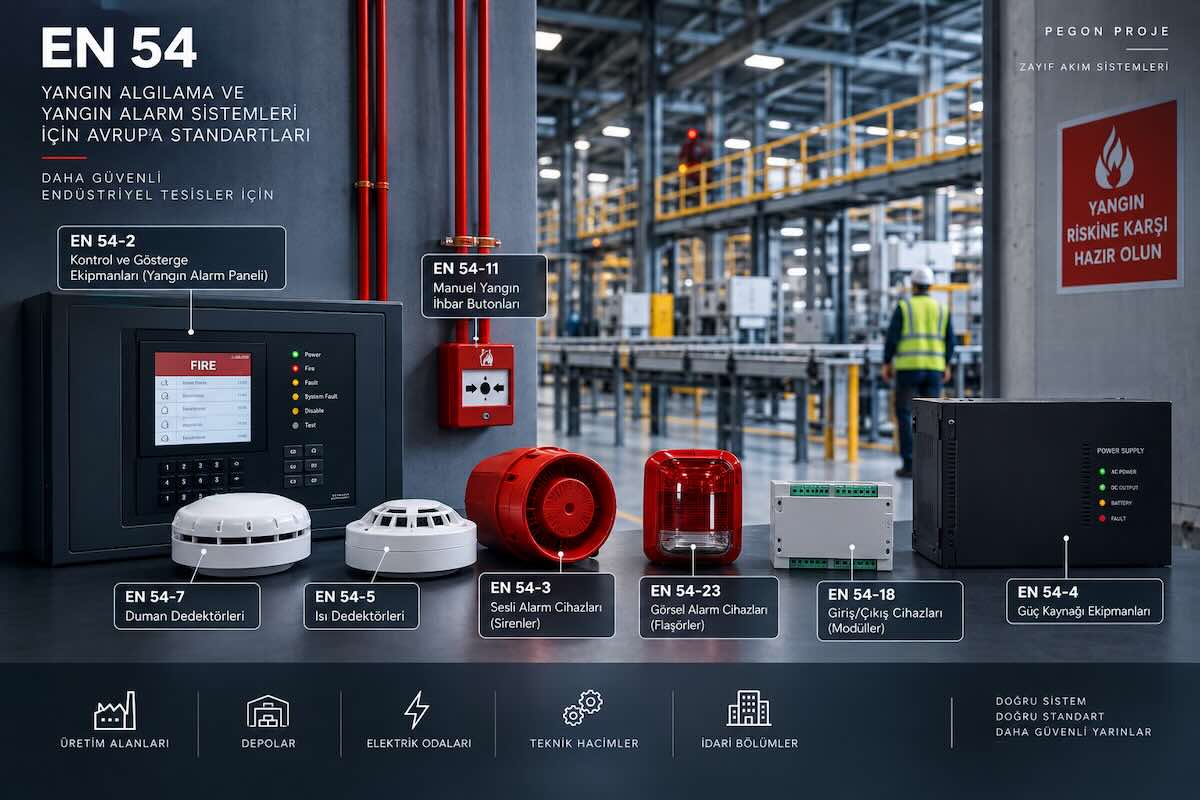
EN 54 is a family of European standards covering requirements and test methods for different components and functions of fire detection and fire alarm systems.
EN 54 is not a single standard. Different parts apply to different system components, including fire alarm control panels, power supply equipment, smoke and heat detectors, manual call points and alarm devices.
Therefore, instead of looking only for the general statement “EN 54 compliant system,” it is important to determine the function of each product and identify which part of EN 54 is relevant to that component.
Why Is EN 54-2 Important for Fire Alarm Control Panels?
EN 54-2 covers requirements for control and indicating equipment used in fire detection and fire alarm systems.
The fire alarm control panel is one of the central components of the system. Information received from detectors, manual call points and other field devices is evaluated by the panel; alarm and fault conditions are displayed, and relevant outputs can be controlled according to the project fire scenario.
For this reason, panel selection should consider not only the number of detectors that can be connected or whether the system is addressable or conventional, but also whether the panel supports the functions required by the project.
EN 54-4 for Power Supply Equipment
EN 54-4 covers requirements for power supply equipment used in fire detection and fire alarm systems.
A fire detection system needs to continue operating during a mains power failure in accordance with applicable project and standard requirements. The power supply and standby power infrastructure are therefore important parts of the overall system design.
When determining power supply capacity, the control panel as well as connected field devices, alarm devices, modules and the total power requirements of the system should be considered.
EN 54-7 for Smoke Detectors
EN 54-7 is associated with point-type smoke detectors.
When selecting a smoke detector, compliance with the relevant standard is not the only consideration. The environment in which the detector will operate should also be evaluated. Dust, steam, aerosols or similar conditions generated by industrial processes can contribute to unwanted alarms if an unsuitable detection technology is selected.
For this reason, using the same type of detector in every area is generally not an appropriate approach for industrial facilities.
EN 54-5 for Heat Detectors
EN 54-5 covers requirements for point-type heat detectors.
Heat detectors can be considered in certain applications where environmental conditions make smoke detection unsuitable. However, automatically replacing smoke detectors with heat detectors is not the correct approach.
The detection technology should be selected according to the fire risk, expected fire development, environmental conditions and the performance objectives of the project.
EN 54-11 for Manual Call Points
EN 54-11 covers manual call points.
Manual call points allow people who discover a fire to manually initiate an alarm. In industrial facilities, their locations should be planned with consideration for escape routes, exits, facility layout and applicable project criteria.
The environmental conditions in which the device will be installed should also be considered. Production areas, outdoor locations and demanding industrial environments may have different requirements from office areas.
EN 54-3 for Fire Alarm Sounders
EN 54-3 covers audible fire alarm devices.
In a factory, it is not sufficient for a sounder simply to operate correctly. The alarm also needs to be perceptible to the people within the relevant area.
Particularly in facilities where production machinery and other equipment create high background noise levels, the positioning of audible alarm devices and the required sound levels should be evaluated as part of the project design.
EN 54-23 for Visual Alarm Devices
EN 54-23 is associated with visual alarm devices used in fire alarm systems.
In areas with high background noise, or where audible alarms alone may not be sufficient, visual alarm devices can be used to support fire warning and notification.
However, the need for visual alarm devices and their positioning should be determined according to the operating conditions of the facility and applicable project requirements.
EN 54-18 for Input/Output Devices
EN 54-18 covers input/output devices used in fire detection and fire alarm systems.
These devices can play an important role when the fire alarm system needs to exchange information with other systems within the scope of the project.
Depending on the defined fire scenario, control and monitoring relationships may be established with smoke control systems, doors, elevators or other building systems.
The required integrations and the equipment to be controlled should be determined according to the fire scenario and the technical requirements of the project.
Why Is EN 54-13 Important for System Compatibility?
A fire detection system may consist of numerous components from different manufacturers or product families. In this case, reviewing the compliance of each individual product may not be sufficient on its own.
EN 54-13 is relevant to the compatibility and connectability of components within fire detection and fire alarm systems.
Therefore, when designing a system architecture consisting of control panels, detectors, modules, alarm devices and other components, their ability to operate together should also be evaluated.
Why Might One Detector Type Not Be Enough in an Industrial Facility?
Different areas within the same factory can have completely different environmental conditions.
For example, a single facility may include:
-
dusty production areas,
-
high-bay warehouses,
-
electrical and switchgear rooms,
-
offices,
-
technical spaces,
-
areas exposed to high temperatures or humidity.
Using the same detection technology in all of these areas may not be appropriate. In addition to point-type smoke or heat detectors, different detection technologies can be evaluated depending on project requirements.
The key approach is to evaluate the environment and fire risk first, then determine the appropriate detection method and relevant standard requirements.
Is EN 54 Compliance Alone Enough?
No. Compliance of a product with the relevant part of EN 54 is important, but it does not by itself create a correctly designed fire detection system.
In addition to equipment compliance, an appropriate system design should consider:
-
risk assessment and the intended use of the facility,
-
detector type and positioning,
-
fire detection zones,
-
alarm and evacuation scenarios,
-
required integrations with other systems,
-
cabling and power infrastructure,
-
testing, commissioning and periodic maintenance requirements.
In other words, using products that comply with relevant standards and creating a properly designed fire detection system are not the same thing.
How Should a Fire Detection System Be Selected for Factories and Industrial Facilities?
Rather than starting directly with a brand or product model, system selection should begin with an assessment of the facility and its risks.
Once production processes, stored materials, environmental conditions, ceiling heights, working areas, technical spaces and fire scenarios have been identified, suitable detection technologies and the appropriate system architecture can be determined.
You can also review the fundamental differences between addressable and conventional system architectures in our What Is the Difference Between Addressable and Conventional Fire Alarm Systems? guide.
Plan Your Industrial Fire Detection Systems with Pegon Proje
At Pegon Proje, we do not approach fire detection systems for factories and industrial facilities solely as an equipment selection process. We evaluate the intended use of the facility, environmental conditions, detection requirements, fire scenarios, system integrations and relevant technical requirements together.
If you are planning a new industrial facility or considering upgrading your existing fire detection infrastructure, we can evaluate the system architecture and equipment requirements according to the needs of your project.
Explore our fire detection infrastructure services on our Fire Detection and Alarm Systems page.
Phone: +90 533 920 99 14
Email: pegon@pegonproje.com