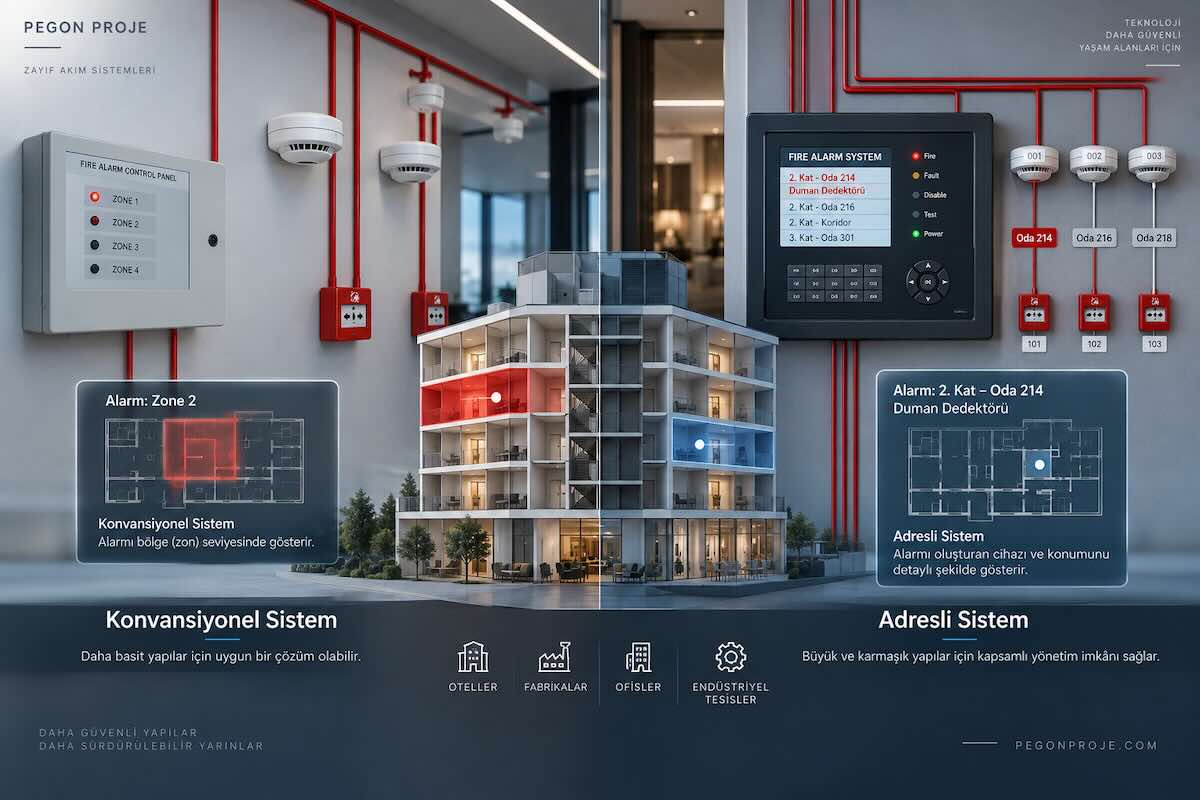
What Is the Difference Between Addressable and Conventional Fire Alarm Systems?
One of the key decisions when designing a fire detection system is choosing between an addressable or conventional fire alarm system.
Both systems are used to detect fire conditions and generate alarms. The main difference is the level of detail with which the system can identify the source of an alarm.
In conventional systems, the zone or area from which the alarm originates is identified, while addressable systems can individually identify the relevant detector, manual call point or field device.
So, what does this difference mean in practice, and which system should be considered for hotels, factories, offices or other commercial buildings?
What Is a Conventional Fire Alarm System?
In conventional fire alarm systems, the building is divided into defined fire detection areas known as zones. Detectors and manual fire alarm call points within the same zone are connected to the fire alarm control panel through the relevant circuit.
When a device generates an alarm, the panel indicates which zone the alarm originated from. However, instead of individually identifying the detector that triggered the alarm, the system generally identifies the relevant area.
For example, if the second floor of a building is designed as a single zone, the panel may display:
“2nd Floor Fire Alarm”
The relevant area then needs to be checked to determine which room or detector generated the alarm.
Where Can Conventional Fire Alarm Systems Be Used?
Conventional systems can be considered for smaller and simpler buildings where fire detection zones can be clearly defined and identifying the source of an alarm at zone level is sufficient.
However, system selection should not be based solely on building size. The intended use of the building, fire risks, zoning requirements, operational scenarios and applicable regulations and standards should all be evaluated together.
What Is an Addressable Fire Alarm System?
In addressable fire alarm systems, compatible detectors, manual fire alarm call points, input/output modules and other addressable field devices are assigned an individual identity or address.
This allows the fire alarm control panel to identify not only the area where an alarm originates but also the specific device that generated it.
For example, the system may provide more precise location information such as:
“2nd Floor – Room 214 – Smoke Detector”
This capability can make it easier to manage alarm and fault information, particularly in buildings with a large number of rooms, floors, production areas or separate spaces.
Key Differences Between Addressable and Conventional Fire Alarm Systems
1. Identifying the Source of an Alarm
Conventional system: Identifies the zone or area from which the alarm originates.
Addressable system: Can identify the addressable device that generated the alarm together with its defined location within the system.
In large and complex buildings, this difference can help operating personnel evaluate the source of an alarm more quickly.
2. System Architecture
In conventional systems, detectors and call points are grouped through zone circuits. In addressable systems, addressable field devices can communicate through loops designed according to the architecture of the system being used.
The cabling and control panel architecture of the two systems are therefore different, and the appropriate system architecture should be determined at the beginning of the project.
3. Fault and Maintenance Monitoring
Because devices can be individually identified in addressable systems, alarm and fault information can be monitored in greater detail depending on the features supported by the system.
In conventional systems, fault or alarm information is generally evaluated through the relevant circuit or zone.
4. Expansion and System Capacity
If a fire detection system may need to be expanded in the future, control panel capacity, loop or zone capacity, existing cabling and device compatibility should be evaluated from the beginning.
Addressable systems can provide more comprehensive management capabilities in large projects with many detection points. However, this does not mean that an addressable system is automatically the correct choice for every project.
5. Fire Scenarios and Integration
Depending on the project scope, fire alarm systems can interact with emergency announcement systems, smoke control systems, elevators, access control systems and other building systems according to defined fire scenarios.
Especially in large projects involving numerous scenarios and field devices, the precise identification and control capabilities of addressable systems can make system management easier.
Is an Addressable System Always Better?
No. Offering more features does not mean that an addressable system is mandatory or the most appropriate solution for every building.
In a small and simple building, a properly designed conventional system may meet the project requirements. In larger buildings with many rooms, floors or separate areas, precise alarm information and more detailed system management may become increasingly important.
For this reason, the right question is not “Which one is better?” but rather “Which system architecture is appropriate for the requirements of this building?”
Addressable or Conventional Fire Alarm System for Hotels?
Hotels may contain a large number of guest rooms, corridors, common areas and technical spaces. Particularly in large hotel and resort projects, the ability to quickly identify the exact point from which an alarm originates can provide an important operational advantage.
For this reason, addressable systems can provide comprehensive management capabilities in large and complex hotel projects.
However, a general assumption that “an addressable system is mandatory simply because the building is a hotel” would not be appropriate. System selection should be based on the characteristics of the building, project criteria and applicable regulations.
Which System Should Be Used in Factories and Industrial Facilities?
In factories and industrial facilities, system selection should not be based solely on the total floor area.
Production areas, warehouses, electrical rooms, technical spaces, administrative areas and areas with different fire risks may all exist within the same facility.
In large or complex facilities, addressable systems can provide important advantages by enabling more detailed identification of alarm and fault locations, monitoring of different field devices and management of fire scenarios.
In smaller and simpler facilities, a conventional system may be considered when it meets the project requirements.
What Should Be Considered When Choosing Between Addressable and Conventional Systems?
Initial investment cost alone is not sufficient when selecting a system. The following criteria should be evaluated together during the design process:
-
building size and intended use,
-
number of floors, rooms and separate areas,
-
fire detection zones,
-
the required level of detail for identifying the source of an alarm,
-
fire scenarios and required integrations with other systems,
-
maintenance and fault monitoring requirements,
-
future expansion plans,
-
applicable regulations, standards and project criteria.
The system architecture should be determined based on these considerations, while detectors, control panels, manual call points, alarm devices and other components should be selected according to the requirements of the project.
Does EN 54 Mean Addressable or Conventional?
No. EN 54 is a family of standards covering different equipment and functions associated with fire detection and fire alarm systems. “Addressable” and “conventional,” on the other hand, describe system architectures.
Therefore, the fact that a system is addressable does not by itself mean that it meets the relevant standard requirements, just as being conventional does not mean that a system cannot comply with applicable standards.
The relevant standards and project requirements should be evaluated separately for control and indicating equipment, power supply equipment, detectors, manual fire alarm call points and other components used within the project.
Evaluate Your Fire Detection System with Pegon Proje
At Pegon Proje, we do not focus solely on choosing between an addressable or conventional fire alarm control panel. We evaluate the building's intended use, architecture, fire risks, detection points, fire scenarios, system integrations and relevant technical requirements together.
If you are planning a new fire detection system for a hotel, factory, industrial facility, office or commercial building, or considering upgrading your existing system, we can determine the appropriate system architecture according to your project requirements.
Explore our fire detection infrastructure services on our Fire Detection and Alarm Systems page.
Phone: +90 533 920 99 14
Email: pegon@pegonproje.com